

Is Your Company Compliant with Oracle's Java Licensing?
Java Stopped Being Free in 2019.
Since Then, the Rules Have Changed Three Times.
In April 2019, Oracle changed its Java licensing model. Free updates stopped for many versions. Paid subscriptions became required for commercial use. Since then, Oracle has updated its terms multiple times — each change shifting what's free, what's paid, and for how long.
The result is a licensing landscape so complex that even experienced teams struggle to keep track. Which versions are still free? Which require a subscription? Which are about to cross into paid territory? The answer depends on the exact version, the release date, and how you're using it.

The licensing complexity trap
Oracle Java licensing isn't a single rule - it's a moving target. Some versions are free for a limited period, others require immediate subscription, and the boundaries shift with every Oracle release cycle. Keeping track manually is nearly impossible - and getting it wrong means retroactive fees.
The audit risk
Oracle actively audits companies. When they find unlicensed installations - and they do - retroactive fees cover every machine, every year, going back to the first violation.
You have more options than you think
Paying Oracle isn't the only way out. Many companies migrate to OpenJDK - a free, fully compatible alternative - and cut their Java licensing costs by 40-50% annually while eliminating compliance risk entirely.
The first step is knowing exactly what you're running.
A 10-minute audit gives you the full picture.
Check Compliance Now ➤Start With What You Have
Whether you have five minutes or a full server inventory, there's an audit path that fits. For the most accurate results, we recommend starting with the Full Audit.
Full Audit
How it works: Your team runs a lightweight collection script on your production servers. It captures every Java installation — version and vendor included — and packages everything into a single ZIP file for analysis.
Why it's the most accurate: Most audits miss installations because they rely on what IT teams think is running. The script finds everything, including forgotten instances, inactive installs, and mixed distributions that manual tracking always misses.
Bulk Version Upload
How it works: Paste your list of Java versions or upload a .txt file. We'll run them against Oracle's licensing rules and flag everything that requires action.
Keep in mind: Results assume all versions are Oracle JDK builds. If you're unsure of your vendor, the Full Audit will give you a more accurate picture.
Quick Check
How it works: Select a Java version from the list. We'll tell you instantly whether it requires a paid Oracle license, when free updates expire, and what your options are.
Keep in mind: Quick Check looks at one version in isolation. It won't surface installations you don't know about.
A Complete Picture of Your
Java Licensing Risk
No jargon, no guesswork.
Your report tells you exactly what you're running, what it's costing you, and what to do about it.


License Status
Every Java installation flagged as compliant, at risk, or in active violation — with a clear explanation of why and what changes.

Security Exposure
End-of-life versions with known CVEs identified across your environment, so your security and compliance teams know exactly where the gaps are.

Upcoming Deadlines
Versions approaching the end of their free period, ranked by urgency. Know what's about to become a problem before it does.

Your Next Move
Every finding comes with a clear recommendation — migrate, upgrade, subscribe, or do nothing. No ambiguity about what action to take.
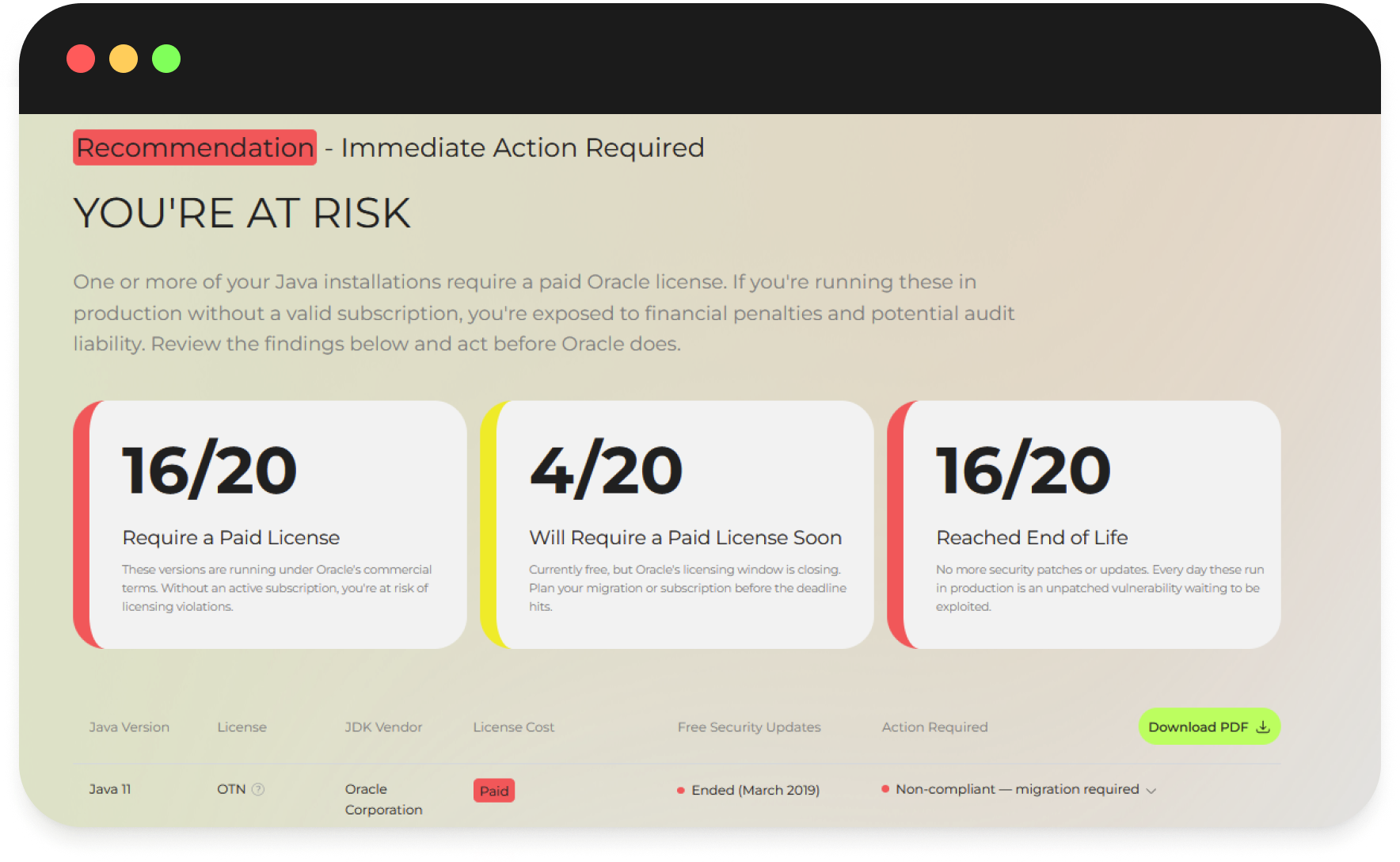
See what a real report looks like
Your results follow the same format with your actual versions, your actual risk, and your actual savings potential.
Every Day Without an Audit Is a Day of Untracked Liability
Oracle licensing violations don't announce themselves. They accumulate silently until an audit letter arrives and the bill covers years of retroactive fees.

The bill arrives retroactively.
Oracle calculates licensing fees per processor, per year, going back to the date of first violation. By the time most companies discover they're non-compliant, they're already looking at years of unpaid fees plus penalties. There's no grace period once Oracle initiates an audit.

Non-compliance fails audits.
Running unlicensed or end-of-life Java in production is a direct flag in SOC2, ISO 27001, PCI-DSS, and HIPAA audits. It can void your cyber insurance policy, trigger regulatory fines, and block enterprise sales to customers who require compliance certification from their vendors.

EOL versions don't get patches.
End-of-life Java versions stop receiving security updates but the vulnerabilities keep coming. Every unpatched CVE in your environment is an open door. The longer EOL software runs in production, the wider that door gets.
One move. Three problems solved.
Migrating to a supported OpenJDK distribution eliminates your licensing costs, removes compliance risk, and keeps your environment patched and secure — all at once. It's not a workaround. Supported distributions like Eclipse Temurin, Azul Zulu, and Amazon Corretto are 100% compatible replacements for Oracle JDK. Thousands of companies have already made the switch — without changing a single line of application code.
Companies that migrate to OpenJDK typically save on Java licensing costs annually — while staying fully compliant and secure.
The audit is free. The cost of skipping it isn't.
Check Compliance Now ➤This Is Happening to Companies Just Like Yours
These aren't hypothetical scenarios. They're real accounts from IT professionals shared publicly in tech communities.

"A company was presented with a $400,000 back-licence bill based on Oracle's calculations. After months of negotiation — challenging Oracle's evidence and demonstrating limited actual usage — they settled for $5,000."
— Documented negotiation case, licensing advisory firm
"We use OpenJDK for a single in-house server application. Somehow Oracle got our company's info — probably because someone downloaded Java from oracle.com at some point. They started emailing individual addresses at our company one by one, trying to find out if we were using Oracle JDK without a subscription. I had to answer personally before they stopped."
— IT professional, r/sysadmin community

"An organisation discovered that having fewer than 30 desktops with licensable Java led to a $300,000 fee demand from Oracle — despite the software already being uninstalled by the time Oracle came knocking."
— Documented case, Java licensing consultancy
"We had a 7-person team migrating legacy Java apps. We had to dedicate one person full-time just to dealing with Oracle. When they found out we were leaving, they audited us and decided our VMs should each be billed as separate full servers — suddenly demanding millions."
— Government IT manager, Slashdot tech community
of Oracle Java users have been audited in the last 3 years (Dimensional Research, survey of 500 IT asset managers, 2025)
of Oracle Java customers are looking to switch to OpenJDK alternatives (Dimensional Research, 2025)
price increase reported by companies switching to Oracle's per-employee model (Gartner, 2023)
Oracle doesn't wait to be invited. Run your audit before they run theirs.
Check Compliance Now ➤FAQ
About the Audit Tool
How do I find out which Java version I'm running?
Open a terminal on any machine and run java -version. It will return the exact version installed on that machine. If you need to collect versions across multiple servers, follow the step-by-step guide in the Full Audit tab - your IT team can gather everything at once using the collection script.
How accurate are the results?
Our licensing data comes directly from Oracle's official documentation at oracle.com and is updated regularly to reflect Oracle's latest licensing terms. That said, Java licensing is complex and every organisation's situation is different - the results are designed to give you a clear and informed starting point, not a legal verdict. We recommend treating your report as a risk assessment, not legal advice. For formal compliance decisions, consult a qualified licensing specialist.
Do I need to involve my IT team?
For Quick Check and Bulk Upload, no - you can run either yourself in minutes. For the Full Audit, yes - your IT team will need to run a lightweight collection script on your production servers. It takes around 10 minutes per server and requires no special permissions beyond standard admin access. The step-by-step guide in the Full Audit tab walks them through the whole process.
About Java Licensing
Is Java really not free anymore?
It depends on which version you're running, who built it, and how you're using it. Oracle changed its licensing terms in 2019, and has updated them several times since. Some versions have a free production window; others require a paid subscription immediately. The rules are genuinely complex - which is exactly why this tool exists.
How does Oracle find out we're non-compliant?
More easily than most companies expect. Oracle tracks downloads from oracle.com - including corporate email accounts and IP addresses - and keeps records for up to seven years. Older Java installations also have auto-update features that regularly contact Oracle's servers, which signals active use. Oracle's own sales and compliance teams also share intelligence, meaning a casual mention of Java in a vendor conversation can trigger a follow-up.
What happens if Oracle audits us?
Oracle typically starts with a friendly email about a "Java usage review" - it rarely looks like an audit at first. If you respond without preparation and share deployment data, you may be inadvertently building their case. If non-compliance is found, Oracle will present a settlement proposal covering retroactive fees calculated per employee, going back to the date of first violation. For a company with 1,000 employees, that opening figure can reach six or seven figures. The bill is almost always negotiable - but the process is stressful, expensive, and entirely avoidable.
We only have a few installations — are we really at risk?
Yes. Oracle's per-employee pricing model means that even a handful of Oracle JDK installations can trigger a subscription requirement covering your entire workforce. There are documented cases of companies with fewer than 30 licensed machines receiving six-figure fee demands. The number of installations is less important than the licensing terms attached to each one.
What is OpenJDK and is it really a safe replacement for Oracle JDK?
OpenJDK is the open-source reference implementation of Java, maintained by a global community and backed by major technology companies. Distributions like Eclipse Temurin, Azul Zulu, and Amazon Corretto are 100% compatible replacements for Oracle JDK - certified to the same Java SE standard. Your applications will run exactly the same way. Thousands of companies across Europe have already migrated, including enterprises running business-critical systems.
About migration
How hard is it to migrate to OpenJDK?
For most environments, it's straightforward - swap Oracle JDK for a supported OpenJDK distribution, test your applications, and you're done. The complexity depends on how many installations you have, whether any applications are tied to specific Oracle JDK versions, and how well-documented your environment is. That's exactly what a migration assessment call is for - to give you a realistic picture of what it involves for your specific setup.
Will our applications still work after migration?
In the vast majority of cases, yes - without any code changes. Supported OpenJDK distributions are certified to the same Java SE specification as Oracle JDK. If your application runs on Oracle JDK today, it will run on Eclipse Temurin, Azul Zulu, or Amazon Corretto. Edge cases exist - typically in applications that rely on Oracle-specific extensions - but these are uncommon and identifiable during a migration assessment.
How much could we actually save?
It depends on your headcount and how many Oracle JDK installations you're running. Under Oracle's current per-employee model, a company with 500 employees could be paying anywhere from $45,000 to $90,000 per year. Companies that migrate to OpenJDK typically cut that to zero. The savings call we offer is specifically designed to calculate your number - based on your actual environment, not a generic estimate.
Where do we start?
Right here. Run a free audit to find out what you're actually running. Your report will tell you what requires immediate action, what's at risk, and where your savings opportunity is. If you want expert guidance on next steps, book a free savings call - we'll walk you through a migration path built around your environment, your budget, and your timeline.

Know Where You Stand Before They Do
A free 10-minute audit is all it takes to find out exactly what you're running, what it's costing you, and how much you could save by switching to OpenJDK. No installation required. Results straight to your inbox.
From upload to results
For companies that migrate to OpenJDK
No sales call unless you want one